MOSC For Practitioners
Helping Supply Chain Leaders Make Better AI & Transformation Decisions
Every supply chain organization faces important decisions throughout the year.
Which transformation initiatives should we prioritize?
Which technologies and providers deserve our attention?
How should we sequence AI initiatives?
How can we validate our strategy and implementation approach?
What risks or organizational challenges might we be overlooking?
What have other organizations experienced when making similar changes?
As AI innovation accelerates, the challenge is no longer finding information.
The challenge is making better decisions.
Masters of Supply Chain (MOSC) is a practitioner-led Supply Chain Decision Support Network connecting organizations with experienced supply chain executives, former leaders, and technology experts.
We help organizations explore emerging capabilities, compare notes with relevant practitioners, validate approaches, identify potential risks, and navigate complex transformation decisions.
Our value is bringing the right experience into the right conversation at the right time.
The New Reality
For decades, enterprise technology decisions were largely driven by IT and dominated by established software providers.
Today, supply chain leaders are evaluating emerging AI capabilities, specialized technology providers, and new operating models across virtually every function—from planning and procurement to manufacturing, inventory, logistics, and decision intelligence.
Technology is evolving rapidly. Transformation initiatives are becoming more interconnected. And decisions increasingly involve not only software, but also processes, organizational structures, skills, governance, and business outcomes.
In a world flooded with information and AI-generated content, trusted human judgment and firsthand experience become increasingly valuable.
The MOSC Decision Support Network
MOSC brings together:
850+ practitioners, former executives, and technology leaders
200+ participating organizations
450+ active supply chain practitioners
62 former Chief Supply Chain Officers and senior executives
100+ emerging AI and technology companies
Our practitioner network includes leaders from organizations such as General Mills, Pfizer, Colgate-Palmolive, Starbucks, Ross Stores, Floor & Decor, AstraZeneca, Roku, Abercrombie & Fitch, McKesson, and 3M.
The value isn't simply access to this network.
It's connecting organizations with relevant experience when they face important decisions.
How Practitioners Engage with MOSC
MOSC combines an active practitioner community, technology intelligence, and focused Decision Support Programs.
1. Stay Informed: Roundtables, Fireside Chats & Intelligence
Our complimentary community provides ongoing access to emerging technologies, AI applications, and supply chain transformation perspectives.
Resources include:
Monthly practitioner-led Roundtables
Expert-led Fireside Chats
Emerging technology interviews
Function-specific AI news and briefings
Practitioner discussions and event recaps
AI Playbook Series
Transformation Leadership content
GenAI-powered search across our knowledge base
These resources help practitioners stay informed about emerging capabilities, implementation experiences, and developments across the supply chain technology landscape.
2. Compare Notes: Practitioner Peer Exchanges
Peer Exchanges are focused, confidential conversations connecting supply chain leaders with practitioners who have faced similar business challenges, technology decisions, or transformation initiatives.
The objective is to compare notes, validate approaches, identify potential risks, and share firsthand implementation experiences.
These conversations can address questions such as:
How have other organizations approached a similar transformation?
Which technologies and providers did they evaluate, and why?
What implementation challenges or unexpected costs emerged?
How did they redesign processes, roles, and decision rights?
What organizational or technical risks should we anticipate?
What would they do differently?
Peer Exchanges may connect your team with practitioners from one external organization or several, depending on the questions being explored.
No vendors. No demos. No selling. Just candid, practitioner-to-practitioner conversations.
Examples of Peer Exchange topics include:
Strategy & Operating Models
AI Strategy and Roadmaps
AI Governance
S&OP Transformation
Global Trade Strategy
Inventory Productivity
Technology Decisions
Decision Intelligence Platforms
AI-Enabled Planning
Procurement AI
Computer Vision
Manufacturing Intelligence
Implementation & Change
Technology Implementation Experiences
Organizational Readiness
AI Skills and Operating Models
Cross-Functional Adoption
Pilot-to-Scale Challenges
The focus is always on the specific decisions and experiences most relevant to participating organizations.
3. Validate Decisions: Tailored Decision Support Programs
For organizations navigating major transformation initiatives, MOSC offers structured Decision Support Programs.
These programs bring relevant practitioner experience, executive advisory, technology intelligence, and research into your transformation at critical decision points.
Rather than managing the transformation itself, MOSC provides an independent external perspective that complements your internal teams, consultants, and technology partners.
Where Can Decision Support Add Value?
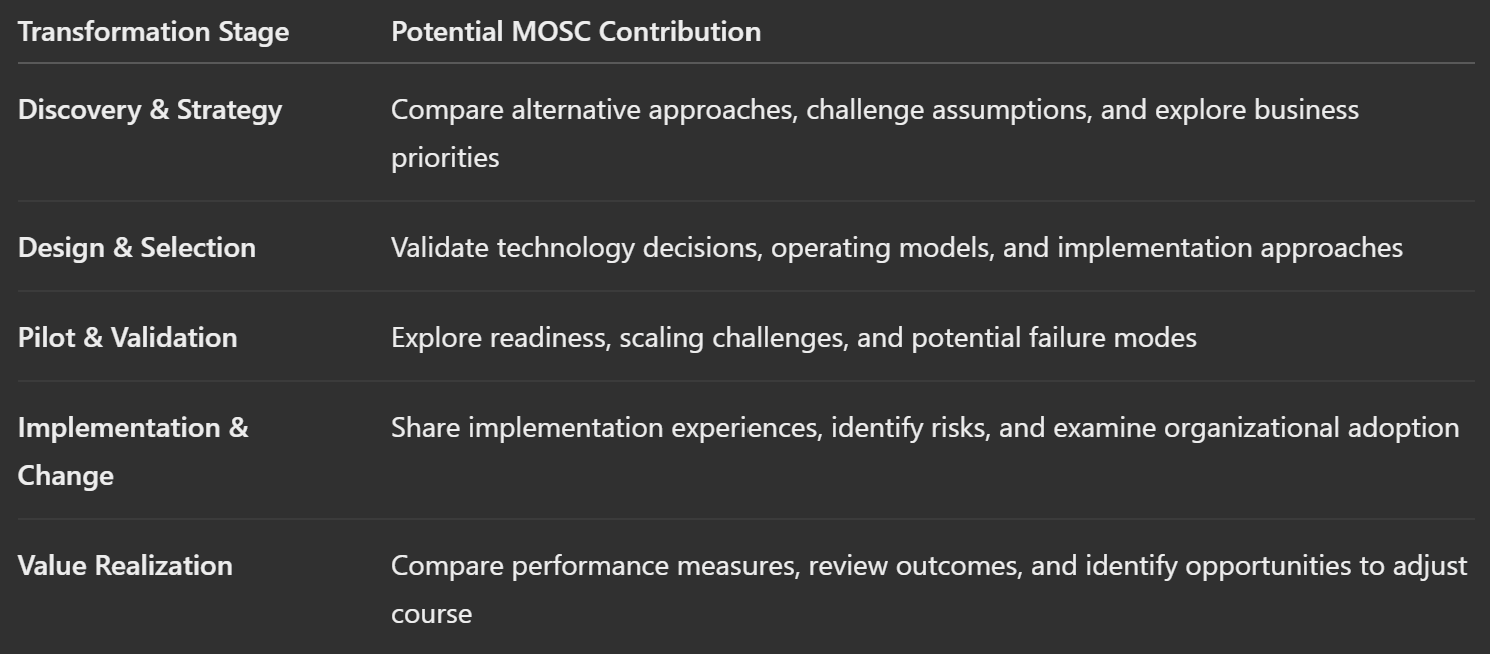
How a Program Works
We start by understanding your initiative, business objectives, current progress, and upcoming decisions.
Together, we develop a Decision Support Roadmap identifying where external practitioner and executive perspectives could add the most value.
Depending on your priorities, a program may combine:
Peer Exchanges: Focused experience-sharing conversations with relevant practitioners
Executive Advisory Sessions: Former CSCOs and senior executives providing independent perspectives and constructive challenges
Custom Technology Interviews: Direct discussions with relevant technology providers about capabilities and implementation considerations
Deep Dive Reports: Focused research and synthesized insights supporting specific decisions
Roadmap Workshops: Structured discussions to review priorities, uncertainties, and upcoming decision points
Engagements are coordinated around your initiative's milestones and can evolve as priorities change.
Some organizations focus on one critical initiative. Others use Decision Support Programs across multiple workstreams throughout the year.
The goal isn't to add more meetings. It's to bring relevant experience into decisions where it can make a meaningful difference.
4. Apply the AI Playbook
For transformations involving artificial intelligence, MOSC's AI Playbook provides an additional framework for exploring strategic and implementation considerations.
The Playbook addresses questions such as:
Which AI opportunities deserve priority?
How should initiatives be sequenced?
What data and technology foundations are required?
How should governance and human oversight work?
What organizational capabilities and skills are needed?
How do we scale applications and measure business value?
Within a Decision Support Program, the AI Playbook can help structure discussions, identify areas for external validation, and connect strategic objectives with practical implementation considerations.
It complements firsthand practitioner experience rather than replacing it.
The Human Advantage
Technology providers can explain what their solutions are designed to accomplish. Consultants can support strategy development and implementation. Industry research can provide broader market perspectives.
Experienced practitioners contribute something different:
Firsthand perspectives from having made similar decisions and navigated comparable implementation challenges.
They can share what worked, what didn't, which assumptions proved incorrect, and which risks were harder to anticipate.
Former CSCOs and senior executives add broader experience in organizational transformation, strategic decision-making, and business value realization.
MOSC brings these perspectives together to help organizations independently pressure-test important decisions.
The objective isn't to copy another organization's approach or simply confirm an existing plan.
It's to make better-informed decisions that fit your own business, capabilities, and priorities.
Why Organizations Engage MOSC
Organizations use MOSC to:
Make better AI, technology, and transformation decisions
Validate strategies, roadmaps, and operating-model approaches
Compare implementation experiences with relevant practitioners
Identify risks and potential blind spots before major commitments
Evaluate emerging technology capabilities and providers
Navigate organizational change and scaling challenges
Strengthen confidence in transformation decisions and business outcomes
Every engagement is organized around one central question:
What perspectives and experiences would help us make a better decision?
Complimentary Community Access
Supply chain practitioners receive complimentary access to the MOSC community, including:
Unlimited Roundtable participation
Unlimited Circle access
Unlimited organizational seats
Function-specific AI briefings
AI Playbook Series
Technology interviews
Transformation Leadership resources
GenAI-powered knowledge assistant
Community participation provides opportunities to connect with practitioners and explore MOSC's resources.
Organizations seeking dedicated support for specific transformation initiatives can engage MOSC through our tailored Decision Support Programs.
Our Vision
The future of supply chain won't be determined simply by which organizations have access to the most information.
It will be shaped by those that consistently make better decisions.
Our ambition is to make relevant practitioner experience and independent executive perspectives available when supply chain organizations face important AI, technology, and transformation decisions.
Better Transformation Decisions. Powered by Your Peers.
Ready to Explore How MOSC Could Support Your Transformation?
If you're preparing for a new initiative—or already navigating one—we'd welcome a conversation about your priorities.
Together, we can identify upcoming decisions, explore where external practitioner experience could help, and outline a tailored Decision Support Roadmap.